 oversea@hichain.com.cn
 +8617328576881





Information
Teach you to learn to estimate the current-carrying capacity of electric wires
Release time: 2024-07-02
At a working temperature of 30°C, the continuous current-carrying capacity under 90% load for the long term is as follows:
- 1.5 mm² — 13A
- 2.5 mm² — 26A
- 4 mm² — 32A
- 6 mm² — 47A
- 16 mm² — 92A
- 25 mm² — 120A
- 35 mm² — 150A
Power conversion from current:
- 1A = 220W, 10A = 2200W, and so on.
For example: If the carrying capacity is 14A for a copper wire, it would be: 220W × 14 = 3080W. Therefore, the power for a 1.5 mm² copper wire is 3.08 kW.
The national standard allows for a long-term current of:
- 4 mm² is 25-32A
- 6 mm² is 32-40A
In fact, these are theoretical safe values, and the extreme values are even higher than these.
The maximum power allowed for a 2.5 mm² copper wire is: 5500W.
For a 4 mm², 8000W, and for a 6 mm², 9000W is also fine.
A 40A digital electricity meter is definitely okay with 9000W. A mechanical one can also handle 12000W without burning out.
Copper core wire allows for a long-term current of:
- 2.5 mm² (16A to 25A)
- 4 mm² (25A to 32A)
- 6 mm² (32A to 40A)
Examples:
1. Each computer consumes about 200-300W (about 1-1.5A), so 10 computers would require a 2.5 mm² copper core wire for power supply; otherwise, a fire may occur.
2. A large 3-horsepower air conditioner consumes about 3000W (about 14A), so one air conditioner would need a separate 2.5 mm² copper core wire for power supply.
3. The incoming line in current housing is generally a 4 mm² copper wire, so the simultaneous use of household electrical appliances should not exceed 25A (i.e., 5500W). Replacing the wires in the house with 6 mm² copper wire is useless because the incoming wire to the electricity meter is 4 mm².
4. In early housing (15 years ago), the incoming line was generally a 2.5 mm² aluminum wire, so the simultaneous use of household electrical appliances should not exceed 13A (i.e., 2800W).
5. Household appliances with high power consumption are: air conditioner 5A (1.2 horsepower), electric water heater 10A, microwave oven 4A, rice cooker 4A, dishwasher 8A, washing machine with drying function 10A, electric water heater 4A.
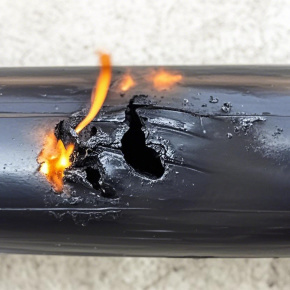
In electrical fires caused by power sources, 90% are due to heat generation at the joints, so all joints must be soldered. Contact devices that cannot be soldered must be replaced every 5-10 years (such as sockets, circuit breakers, etc.).
Copper core wire and cable carrying capacity standard carrying capacity mnemonic for estimation:
- For 2.5 and below, multiply by nine, then subtract one for each size up. For 35, multiply by 3.5, and for pairs from 50 and above, subtract 0.5 for each group. Adjust for conditions, at high temperatures, take 90% for copper upgrade.
- For pipes with 2, 3, or 4 wires, the carrying capacity is reduced by 8, 7, and 6 respectively.
Explanation:
This mnemonic does not directly state the carrying capacity (safe current) of various insulated wires (rubber and plastic insulated wires), but rather represents it as "cross-sectional area multiplied by a certain multiple", which is calculated mentally.
"For 2.5 and below, multiply by nine, then subtract one for each size up" means that for various aluminum-core insulated wires of 2.5 mm² and below, their carrying capacity is about 9 times the cross-sectional area. For example, a 2.5 mm² wire has a carrying capacity of 2.5 × 9 = 22.5 (A). For wires 4 mm² and above, the carrying capacity and the multiple of the cross-sectional area decrease by 1 for each wire size, that is, 4 × 8, 6 × 7, 10 × 6, 16 × 5, 25 × 4.
"For 35, multiply by 3.5, and for pairs from 50 and above, subtract 0.5 for each group", means that the carrying capacity for a 35 mm² wire is 3.5 times the cross-sectional area, that is, 35 × 3.5 = 122.5 (A). For wires 50 mm² and above, the relationship between the carrying capacity and the cross-sectional area becomes two sizes per group, with the multiple decreasing by 0.5 each time. That is, the carrying capacity for 50 and 70 mm² wires is 3 times the cross-sectional area; for 95 and 120 mm² wires, it is 2.5 times the cross-sectional area, and so on.
"Adjust for conditions, at high temperatures, take 90% for copper upgrade". The above mnemonic is for copper-core insulated wires, laid in an environment with a temperature of 25°C. If aluminum-core insulated wires are laid in areas where the environmental temperature is higher than 25°C for a long time, the carrying capacity of the wires can be calculated using the above mnemonic, and then take 90% of it; when using copper-core insulated wires instead of aluminum wires, their carrying capacity is slightly larger than that of aluminum wires of the same specification, which can be calculated using the above mnemonic, and increase the carrying capacity by one wire size compared to aluminum wires. For example, the carrying capacity for a 16 mm² copper wire can be calculated as for a 25 mm² aluminum wire.
Please note that the translation provided is a direct translation of the technical content and may require adaptation for specific technical terms used in the electrical industry

Contact Information

Email: oversea@hichain.com.cn

whatsapp: +852 51665706

Copyright ©2023 Hichain Electricity (Zhaoqing) Co.,Ltd. |